Showing posts with label Paraphernalia. Show all posts

Thursday, May 7, 2026

A Review of the Godbole FlatLay A5 Notebook Cover

PRELUDE

In search of a suitable notebook cover

My fondness for smooth, writing-friendly paper predates my understanding of what paper quality even meant. Back then, there were notebooks capable of robbing a ballpoint pen’s tungsten-carbide ball of its spherical structure - let alone being safe for fountain pens. During my school years, there existed a premium category of Oxford Exercise Notebooks (from a Kolkata-based company), ruled with blurple lines - ink that promises blue but renders purple. These days, blurples are exactly the kind of inks I avoid.

         Later came the acquired appreciation for fountain pen friendly paper, along with the fascination of seeing ink reveal its inherent shading and character. Like many others, I settled on the A5 format as the ideal everyday-carry notebook size, though I still prefer the broader B5 dimensions for desk writing.

         Years ago, I used to get MD notebooks from Japan - back when the prices were still sane. Both the MD and Life notebooks fit nicely inside Midori’s A5 transparent plastic cover. But over time, I wanted something more permanent for softcover notebooks, which inevitably led me toward that well-known island of infinite craving: the internet, now fortified with AI-powered searches that seem to understand my purchasing habits better than I do.

I had three conditions:

  • I wanted something durable. Full-grain leather was preferable, though I wouldn’t object to good top-grain leather either. Personally, I feel PU “vegan” leather is among the worst things to happen in the name of sustainability - an endless cycle of replacement disguised as an environmental virtue.
  • The cover needed to lie flat on a desk and comfortably accommodate a 100 sheet notebook.
  • I did not want excessive pockets, organizers, or pen loops. Too many compartments defeat the purpose of a minimalist notebook cover. I can already carry my phone and pen in my pockets; I don’t need my notebook cover moonlighting as a wallet.

Here were some of the expensive, occasionally absurd options I considered:

  • Galen A5 Leather Cover - $54 + shipping
  • MD A5 Goat Leather Cover - $128 + shipping (at that price you could probably buy an entire goat here)
  • Superior Labor A5 Leather Notebook Cover - $170 + shipping (absolutely not)
  • Lapis Bard A5 Leather Jacket - Cognac - $49 (actually very reasonable for the quality)

             At the time I was in the US, so naturally my search results leaned toward the most expensive possibilities available. Eventually I refined my search to products available locally in India, and that is how I came across a company called Godbole Gear

           For those wondering, Godbole is a Marathi surname. From their website I learned that Juhi Salinkar and Gaurav Godbole - both engineers by education and previous profession - decided to pursue leathercraft full-time after relocating back to India. Kudos to them. Someday, perhaps. Among their offerings were the A5 and A6 FlatLay notebook covers under the Special Edition section.

A LITTLE BACKGROUND

The myriad permutations of leather-craft

Godbole Gear emphasizes the use of saddle stitching: famously associated with Hermès, where every stitch is locked independently using two needles. The advantage is simple: even if one stitch fails, the rest do not unravel.

What interested me more, however, was Gaurav’s story behind designing the FlatLay cover. It echoed exactly the sort of frustrations I had with with some notebook covers and aligned closely with what I had been searching for.

The company also highlights its use of full-grain leather across its products. If you’ve never ventured into the intricate world of leather grades and finishes, here's the condensed version:

  1. Full Grain: The highest quality. A cut of leather consisting of the outer layer of hide, left unsanded and unbuffed to retain its natural imperfections. It has a strong and durable surface.
  2. Top Grain: The top layer is sanded to remove imperfections, which reduces some of the strength and water-repellent qualities of full grain leather. It is commonly used in handbags, wallets, and shoes.
  3. Corrected: A broader term often referred to as genuine leather. It can be any layer of hide that has been treated to create a uniform surface. Commonly used in belts, wallets, bags, gloves, and shoes.
  4. Split Grain: A layer cut from the lower levels of top grain leather. It is not as dense, tight, or durable as full grain or top grain leather.
  5. Reconstituted & Recycled: Leather scraps are bonded together using polyurethane or latex. 

Here are a list of leather finishes:

  1. Aniline: Dyes allow natural surface of leather to show through. 
  2. Semi-Aniline: Similar to aniline but with added pigments.
  3. Faux: Also known as PU, Vegan or Vinyl leather. Is made of polyurethane and made to mimic real leather.
  4. There are many more types (12+), but they may not be relevant to our search for pen cases and sleeves.

        Leather tanning is the process of treating hides to clean them of dirt, blood, and hair. This process alters the protein structure of the hide to make the leather durable and less susceptible to decomposition. 

  1. Vegetable tanning: This method uses natural materials or tannins derived from plants and bark, which are astringents. It’s an ancient, environmentally friendly process.
  2. Chromium tanning: Chromium sulfate is used for a faster and cheaper tanning process, offering more color options than vegetable tanning. The hair and flesh are removed before the tanning process.

There are, of course, many more variations, though those are less relevant to notebook covers and pen accessories.

I’ve also had good experiences with top-grain leather products from Khyati’s company, The Black Canvas, based in Mumbai. Good top-grain leather, when properly cared for, lasts remarkably well too. Some of my luggage tags from The Black Canvas have survived years of long-haul flight abuse without complaint. 

Although the fit and finish of Godbole Gear can surpass many established international brands.

DESIGN

Minimalistically simple

The FlatLay cover is available in four primary colours - Mahogany, Chestnut, Black, and Racing Green; along with several thread options including red, white, black, chestnut, and dark brown. All of them look subtly stunning.

             I ordered the Racing Green A5 version with red stitching and monogramming simply because it looked different with a sense of subtlety. After placing the order, I received a confirmation email along with an estimated wait time of roughly 3-4 weeks. By the time I had recovered from jet lag, the cover had arrived.

The packaging was minimal: a simple craft-paper sleeve accompanied by a handwritten note from Juhi and Gaurav. It was thoughtfully done, although I sincerely hope one of them eventually falls into the fountain pen universe. If you’re making objects this beautiful for writers, you deserve equally good writing instruments.

The first thing I noticed upon unwrapping the cover was the stitching. The seams are elegant, precise, and remarkable. My monogram, blurred in the photographs was subtly embossed in a nice typeface.

Two external pen loops help secure the notebook closed. They comfortably accommodate slimmer pens up to roughly the diameter of a Lamy 2000 multipen (~12.6 mm). A standard Lamy 2000 fountain pen is too thick, while a Parker 51 fits comfortably.

           Personally, I would rather subject a Rotring 800 or Rapid Pro to the tension of holding the flaps shut than risk stressing one of my fountain pens, but that decision ultimately depends on your tolerance for mechanical anxiety.

              As you open the cover, you will notice that the beautiful stitching runs consistently across both the front and back. True to its branding, the cover lays perfectly flat on a table. There are two large slip pockets designed to hold a notebook, along with cards and other small items. The bottom of the right slip pocket carries the subtle “Godbole Handmade Leather Gear, Estd. 2014” imprint. You can use the right pocket to secure your notebook, while the left pocket is ideal for storing thin journalling essentials such as stickers, cards or bookmarks.

MATERIAL

The cover uses full-grain, vegetable-tanned aniline buffalo calf leather with a thickness ranging from roughly 1.2 mm internally to 2.4 mm externally, as per the website. This gives the cover structure and rigidity without resorting to cardboard fillers. It certainly appears durable, though only long-term use can validate that claim. Based on my experience with Midori leather covers and other full-grain leather accessories, however, I have little doubt about its durability.

       Truthfully, even a good top-grain leather product can last decades with occasional maintenance - with beeswax and exposure to sun rather than being kept inside dark drawers. Like all natural leather products, mold can become an issue if stored in dark and humid environments. However it’s easy to clean and moisturise them with a little beeswax.

FIT & FEEL

The leather retains visible grain patterns and feels smooth without becoming slippery. There is a certain warmth and familiarity to leather that synthetic materials still struggle to replicate. The cover is approximately 10% larger than a standard A5 notebook and comfortably accommodates notebooks up to roughly 18 mm thick. I currently use it with a thick Muji A5 ruled notebook swollen with photographs and paper cut-outs carrying some emotional value.

The A5 notebook fits snugly into the right slip pocket. Dimensionally, the cover measures around 165 mm × 230 mm and works well with standard A5 notebooks (150 mm × 210 mm). However, wider notebooks like Clairefontaine’s French-ruled notebooks (165mm x 210 mm) do not fit.

Here is the cover compared alongside my 10-year old Midori Traveler’s Notebook in passport size.

Here is the cover compared alongside my 11-year old Midori Traveler’s Notebook in standard size (130mm x 210mm).

FINAL COMMENTS

After several years of using notebook systems ranging from Midori Traveler’s Notebooks to simple plastic covers, I have realised that sometimes we need a touch of luxury to appreciate the emotional value that these notebooks carry for us.

            I prefer notebook covers that disappear into use rather than constantly demanding attention through excessive organization features or over-designed interiors. The FlatLay succeeds precisely because it isn’t over-designed It keeps the notebook flat, feels reassuringly comfortable to use and is beautifully handcrafted. The cover never tries to appear luxurious, it simply is. If I were to suggest a single change, I would love to see an option without the external pen loops, perhaps paired with a different closure system.

You can find my other pen and paraphernalia reviews here

REFERENCES

Sunday, April 10, 2016

The Traveler’s Notebook (Passport) Review

A year of travel with my regular brown MTN (Midori Traveler’s Notebook) has gone by and I could not resist an urge to get another, this time perhaps a more portable one. Not the ultra portable (thumb drive kind) 10th Anniversary Notebook Mini (below), which stupendously completes itself within a span of 5 centimetres. This one had to be a passport, possibly with the recent branding of Traveler’s Company, Japan

You can find a review of the regular sized MTN here. Or should I say TN!

           Midori as many of you know is in fact is a 66-year old Japanese company specializing in paper products and creative design stationery. You may also bump into MD Paper, while searching for quality paper products across the Asian market. If you are not very familiar with the Traveler’s company brand, I can rest assure you that it is a rather recent development of 2016. The traveler’s notebooks which were marketed earlier under Midori brand of products, have been rebranded under Traveler’s Company, Japan. Additionally this Traveler’s Company is hosting a few other older product lines including spiral notebooks, kraft paper envelopes & the usual brass stationeries. The core part of the notebook i.e the paper is manufactured in Japan whereas the leather cover is finished by hand in the old city of Chiang Mai, Thailand. The Traveler’s Notebook comes in two different sizes – Passport & Regular. Though it used to come across two standard colour variants i.e black & brown, there is a third Camel colour available now, which was released as limited runs before. Also a few other limited colour runs (say: Blue) are released by Midori from time to time.


DESIGN & PERFORMANCE (6/6)


Multi-tier packaging. Not expensive, but Differentiated! A polyethylene plastic wrap, diaphanously enclosing a package wrapped in traditional brown paper, increases the excitement of unwrapping a gift. And you can also use the brown paper for a bit of nib smoothing! A note on the front of the package in traditional Japanese paper, reveals that the leather cover ages with time and use. 

Another at the back pictorially explains the four enclosures inside - Cotton Bag, Leather Cover, Blank Refill & Spare Rubber Band. It also makes a promise that the paper of the enclosed refill (notebook) is resistant to bleed-through (although there is some ghosting), but you can say that there is always a tomoe-river refill available, to simultaneously feel & enjoy ghosting to the maximum!

On opening the brown envelope, you can find the notebook enclosed within a white cotton bag. 

You get two spare rubber bands (green & brown). You can also remove the brown one from the enclosure, to use it with the TN.

Now the TN Passport is unveiled. You are right, it’s the Camel one :). The leather enclosure is secured by an orange rubber band going through a perforation at the back, expresses both sense and simplicity in design. The cover is made of cowhide, ensconcing an elemental texture and I can say from experience that it acquires character over time. It’s supposed to scratch, change colour over time to transform into your signature dated companion. A note explains that the leather has been naturally dyed to retain the texture and wetness could result in coloration of immediate things touching it. To remove blemishes, you can use a normal leather cream (the white one), the one you might have used on your shoes/belts.

The TN carries a single stitched notebook with blank pages (Refill#003). Two strings running across the notebook and the leather cover through multiple perforations are anchored by a small tin clasp, placed at the top-left end of the notebook system. The rubber band fastens the notebook and the rather loosely held non-elastic one is meant to be a bookmark.

As stated in the other review, the economy of this notebook is primarily based on an Add-On model: base + spares, like the Gillette razor-blade model or a Sony PS. But again, Sony too sells its PlayStation at a loss and makes up for the same with the entire gaming economy. So, the ecosystem for the traveler notebook consists of two categories of refills – Notebooks and Accessories. Notebook refills primarily come in 64 pages (both sides) across lined (001), grid (002), blank (003) and lightweight Tomoe-River paper (005) variants. You can accessorize your traveler with pocket-sticker (022) or a camel color pen-holder (015/016), once you purchase the refills, but your only concern could be regarding the price which ranges between $4 to $10. There are several other inserts that are available for the TN. Some older ones have been discontinued. You can find a complete list of refills for the passport sized TN here.

            I had ordered two passport sized refills along with this TN - Refill#002 & 005, both have a simple wrap with a coloured stamp conveying the necessary details including the type of paper and number of pages in it.

Adding a refill notebook to TN is pretty easy, by using one of the spare elastic bands to connect the new notebook with an existing one.

The elastic band needs to be secured & adjusted around the spine of both these notebooks. 

Embossed at its bottom-left corner of the back cover is the newer 2016 branding of TRAVELER’S notebook & TRAVELER’S COMPANY, JAPAN & MADE IN THAILAND instead of the earlier MIDORI & MADE IN THAILAND. And that is the only visible change.


PHYSICS OF IT (4/6) – RELATIVELY SPEAKING


The dimensions of the TN Passport size are 10 X 13.5 cm , with a thickness of 1.2-1.5 cm with two standard 64 page refills.

A passport is quite portable compared to a regular sized TN. However, I am more at ease with the regular size, given my writing style and preferences. The TN Passport could score very well for other who have a smaller handwriting size. 


ECONOMIC VALUE (3/6)


The traveler notebook and two 64-pages refill cost me around USD 46, with shipping from Japan. While the price might still be low for a comparative analysis (with other shops), it’s still a notebook and a rather small one for me. And once you are locked in, you might have to purchase refills typically costing anywhere between $4 to $10. That’s TN’s formulae for gross margins. TN is also facing increasing competition in e-com from newer & newer faces like 1, 2 and many others.


OVERALL (4.3/6)


Exquisite Design. Yes. First Mover. That too. MD paper is nice, thick and smooth for all your beloved nibs & inks. I tested a medium nib of Pilot Custom 823 running on Iroshizuku Yama Budo ink inside. And it ran smoothly leaving behind the right amount of ink for shading. The thickness and texture of the MD paper makes even a relatively wet ink dry up pretty fast (less than 18 seconds). Although there is a bit of ghosting.

It’s a subjective opinion and you might like the passport more than the regular. I find the regular handy. Then on the inside cover of each refill you have a midori styled passport page to note down your passport details. It’s illogical to travel with this & without your passport, but I still like that act. So if you have already developed a similar cerebral logic and love the style, then get it! Else wait for a year or two and get a limited run to add to your pen & paraphernalia collection.

Thank you for going through this review. 
You can find some more pen and paraphernalia reviews here.


REFERENCES


Sunday, July 12, 2015

The Visconti Dreamtouch 6-Pen Case

I was looking for a quality pen-case for quite sometime, which could also serve as a handy storage of my fountain pens, outside their hefty boxes. Existence of nice fountain pens, necessitates invention of great fountain pen cases. I do use a Pelikan 3-pen case to carry my daily fountain pens, but I required something more secure, which can double up as a travel companion, if I ever intend to carry more than three pens at a time. The Dreamtouch leather series were launched sometime in 2012. For the leather pen cases, Visconti offers 5 variants in an ensemble of a compact and unique design, housing 1/2/3/6/12 pens.

PRESENTATION


As usual, there is a white Visconti fabric pouch, inside which the case rests once you take it out of the cardboard box. It ensures that the leather remains intact and unscathed before use.


DESIGN & BUILD (6/6)


The outside is made of aniline-calfskin with a clean and precise workmanship. Aniline leather making techniques preserve the natural surface of hide and render a soft natural feel of the same. The flip side is they do indeed carry the natural porosity of skin. When you look at the threads and feel the case you would instantly know, that you have landed upon great workmanship.


Then at the top of the flap, there is the V logo inside an ellipse, which is made of chrome plated metal. It seems minimalist aesthetically, but it does succeed in drawing your attention. The zip looks flat and compact, converging with the geometrical dimensions of the case. You will neither find the case too pliable nor you would find it too hard. A very compact case indeed!


The rear-end is plain and coveys volumes instead.


The flap converges with the overall flat design quite well.


The slider is chrome plated metal and sports the same logo which is present on finials of Visconti pens. The name VISCONTI lies within a mirrored V


The back-side sports an embossed VISCONTI with the name of its birthplace, the renaissance town FIRENZE


PHYSICS & PERFORMANCE (5/6)


The 6-pen case weighing around 150 grams and is quite light and easy to hold. It can hold a pen upto 15.5 cm of length. A thicker pen will of course displace the divider by a tiny bit. The flat design of the case, makes it a convenient storage box. I just love the compactness of this case.

  • Length ~ 16 cm
  • Width ~ 14 cm
  • Depth ~ 2.7 cm
A 15 cm scale can completely rest inside with some additional pen-room.
You can observe that the dividers are placed at least 2.3 cm apart, which makes it capable of housing most of the pens. The inside linings are made of black velvet, a touch would reveal it's quite dense and should protect your pens well. One downside is that all the pens will not fit snugly inside these slots and there are chances of bumping inside it, in case you are travelling.


The finial of a rather large pen like an Izumo (>16 cm) can become exposed to the zipper material. Had it been a metallic finial with a flat top (say Pelikan), there are chances of scratches, due to lack of any additional protective lining on its insides. Although the zippers have plastic teeth, the slider with its metallic clasp still has to traverse along these lines.

From left to right : Pelikan m605, m805, Platinum Izumo Tagayasan, MB146, Pilot Custom 823 and a Visconti Homo Sapiens Maxi.

A dimensional comparison with a Pelikan TG32 (black/green) 3-pen case


ECONOMIC VALUE (6/6)


Although the 6-pen case retails in the market at around USD 120, I was able to win this one in an auction, at around USD 77. From time to time, I do find multiple auctions for these cases running on the bay.  I feel that's a good price for any aniline leather product.

OVERALL (5.7/6)


Overall, I do feel that the 6-Pen Dreamtouch case has been a nice buy, custom made to my requirements of compactness and aesthetics. It is subtle yet elegant at the same time. I would keep the large pens inside their boxes.

More pen and paraphernalia reviews here.

Saturday, May 2, 2015

Midori MD Notebook Review (A5)

After falling in love with my MTN and the entire ecosystem part of it, I wanted to have a similar fountain pen friendly paper, sans the panache of an MTN. And it’s closest cousin seemed to be an MD notebook. I went for a A5 sized one, as it was quite readily available.

PRESENTATION (6/6)


The entire package rests within a polyethylene plastic wrap, and a tracing paper enclosure keeps you happy with the very process of unravelling. There is a bottom band of blue branding wrapped over the notebook, which covers essential product specifications/branding in English and certain things in Japanese.

MD ELEMENTS (6/6)


The notebook is thread-stitched and a weaved cloth is glued along the outer-spine, perhaps as an embellishment for a classical literary look. You would feel at ease, to write on a MD Notebook, as it remains completely open, thanks to the stitching. Clever! A ribbon/bookmark can be found in the middle, and I feel it is quite well-thought of, in case you choose to mark something essential.
The cover is made up of card stock usually meant for business cards, post cards or catalogue covers. On the front, it carries the branding of ‘MD PAPER, Made in Japan’, in a subtly embossed format.
As an ecosystem refill, a clear PVC cover is also available for each of the notebook sizes, in case you are planning to use a particular size regularly.

There are four stickers to label your notebook.

The inside cover has a box of particulars along with a bit of MD branding.


PHYSICS OF IT (6/6) – RELATIVELY SPEAKING


Quite a compact one with dimensions - L(21 cm) X W (14.8 cm) X H (1.1 cm), it does get a bit wider and shorter, than a standard parker A5 notebook or even an MTN. It has 88 leaves with square grids (of 0.5 cm) on both sides.

ECONOMIC VALUE (6/6)


It cost me a pretty decent USD 9 with some combined shipping from Japan. I ordered it online on Rakuten global.

OVERALL PERFORMANCE (5/6)


I love the understated looks of this notebook. A Pelikan fine nib glides along the paper with a wet line although it takes around half a minute to dry. I did observe a minute feathering and a decent show-through after writing on the first page. I have observed that one specific ink, i.e Montblanc Toffee Brown in Japanese nibs tends to skip sometimes on this paper. Though it does well enough with deeper feed channels of European nibs.

Unlike the MTN refill paper, these pages are quite thin and  the ghosting is visible on the other side. Although from a personal context. I feel that you can write on the other side too but YMMV.

I hope you enjoyed this short review and it helps with your next notebook purchase.

Sunday, March 15, 2015

A bookish review of the Midori Traveler’s Notebook

Lately, along with a fair bit of travel, my focus has shifted towards acquiring various paraphernalia, genetically consistent with the core fountain pen ecosystem, while the pen themselves are in transit. Having used parker notebooks with the usual ivory coloured paper, for my travelogues; I was fascinated by the idea of a notebook  enclosed in a traditional manner within a leather jacket. To my limited knowledge and much elation, the Midori Traveler Notebook came out to be much more than that. I came in touch with the Midori brand, when I had got myself an aluminium multiple ruler. As per their website, Midori is a 65-year old Japanese company specializing in paper products and creative design stationery. You may also bump into MD Paper, while searching for quality paper products across Asia. 
From the perspective of paper, the company also makes stitched notebooks along with the flagship Traveler Notebook. And the core part of the notebook i.e paper manufacturing remains with Midori, Japan. Traveler Notebook comes in two different sizes – Passport & Regular across two standard colour variants – black & brown. (Additionally a blue - special edition is being released in April - 2015). The one being reviewed here is a regular sized traveler notebook.


PRESENTATION (6/6)


One of the enchanting parts of the notebook is the multi-tier packaging. Nothing expensive, but enticingly ‘differentiated’! A polyethylene plastic wrap, diaphanously enclosing a package wrapped in traditional brown paper, increases the excitement for unwrapping the gift. A note on the Traveler’s notebook in traditional Japanese paper, reveals a consistent purpose and description. It does reveal that the brown leather jacket is handmade in Chiangmai, Thailand, whereas the notebook is manufactured in Japan, thus referencing and embellishing quality.

At the backside of the package, rests some information regarding manufacture of the notebook and the leather jacket – from the countries of JAPAN and THAILAND respectively, along with product/bar codes and other compliance details in Japanese script. The brown package is fastened with a reddish-brown elastic band.

Opening the package, unveils a notebook enclosed in a white cotton bag. Additionally, one spare elastic band (orange) is provided in a poly-pack. You can also remove the reddish-brown elastic band from the outer enclosure.

I had also ordered a 64-page refill along with the notebook (Refill#001), which has a simple wrap with a coloured stamp conveying the details of it.

DESIGN (6/6)


A leather enclosure secured by a single brown elastic band going through a perforation at the back of it, expresses the sense and simplicity part of it. The cover is made from cowhide leather, with an elemental texture and it acquires grace with time. It’s supposed to scratch, acquire colour over time to transform into your signature companion.

The enclosure carries one single stitched notebook with blank pages (Refill#003). There is a series of two strings running across the notebook and the leather cover through multiple perforations on the it and those are anchored by a small tin clasp placed at the top-left end of the notebook system. The elastic band fastens the notebook while the rather loosely held non-elastic one is meant to be a bookmark. The only embossed mark on the leather jacket is at the botton-left side of the back cover, which states MIDORI & MADE IN THAILAND.
The design of the notebook is primarily based upon an Add-On model: base + spares like the Gillette razor-blade model. But again Sony too sells the PlayStation at a loss and makes up for the same with the entire gaming ecosystem.
So, the primary ecosystem for the traveler notebook consists of two categories of refills – notebook and accessory. Notebook refills come in 64 pages (both sides) across blank (003), lined (001), grid (002), monthly planner (005), lightweight paper (128 pages, 013) and kraft paper (014). Accessorizing your traveler with sticky notes (022) or film album (023) or a pen-holder (015/016) is pretty easy once you purchase the refills and they may be priced between $4 to $10. There are several other inserts that are available for the traveler from Midori. You can find a complete list here.

PERFORMANCE (6/6)


The enclosing elastic band can be replaced with another by pulling it out from the inside of the back-cover. 
Adding a notebook is easy, by using one of the spare elastic bands to connect the new notebook with the existing one, which needs securing the band around the spine of both these notebooks. I have covered the writing part of it in the last section.

UPDATE 2.0


Off late, I did add a blue Midori PAN AM pen holder refill, which can keep a pen or a pencil with diameter less than 1.2 cm. Though it’s meant to go with MTN’s blue special edition, I ordered it for my regular brown MTN. 


PHYSICS OF IT (4/6) – RELATIVELY SPEAKING


A very portable one, the dimensions (13 X 21 cm) match closely with the standard parker notebook. However, given the availability of pages (192 in parker) and an absence of a pen-holder, the parker does score some brownie points here. If you are looking for pure table-top writing experience, then parker can be more appealing, given its solid frame. The leather cover does offer a lot of flexibility when you are travelling and it’s meant for the traveller.


ECONOMIC VALUE (4/6)


The traveler notebook and a 64-page refill cost me around USD 35, with free shipping from Japan. While the price might still be low for a comparative analysis (with other shops), the economic value of the notebook does not do very well against the likes of competition - parker costs less than one-fourth of the same. Then again, you have to purchase refills typically costing anywhere between $4 to $10. That’s midori’s ecosystem for making money. The Add-On model!

OVERALL (5/6)


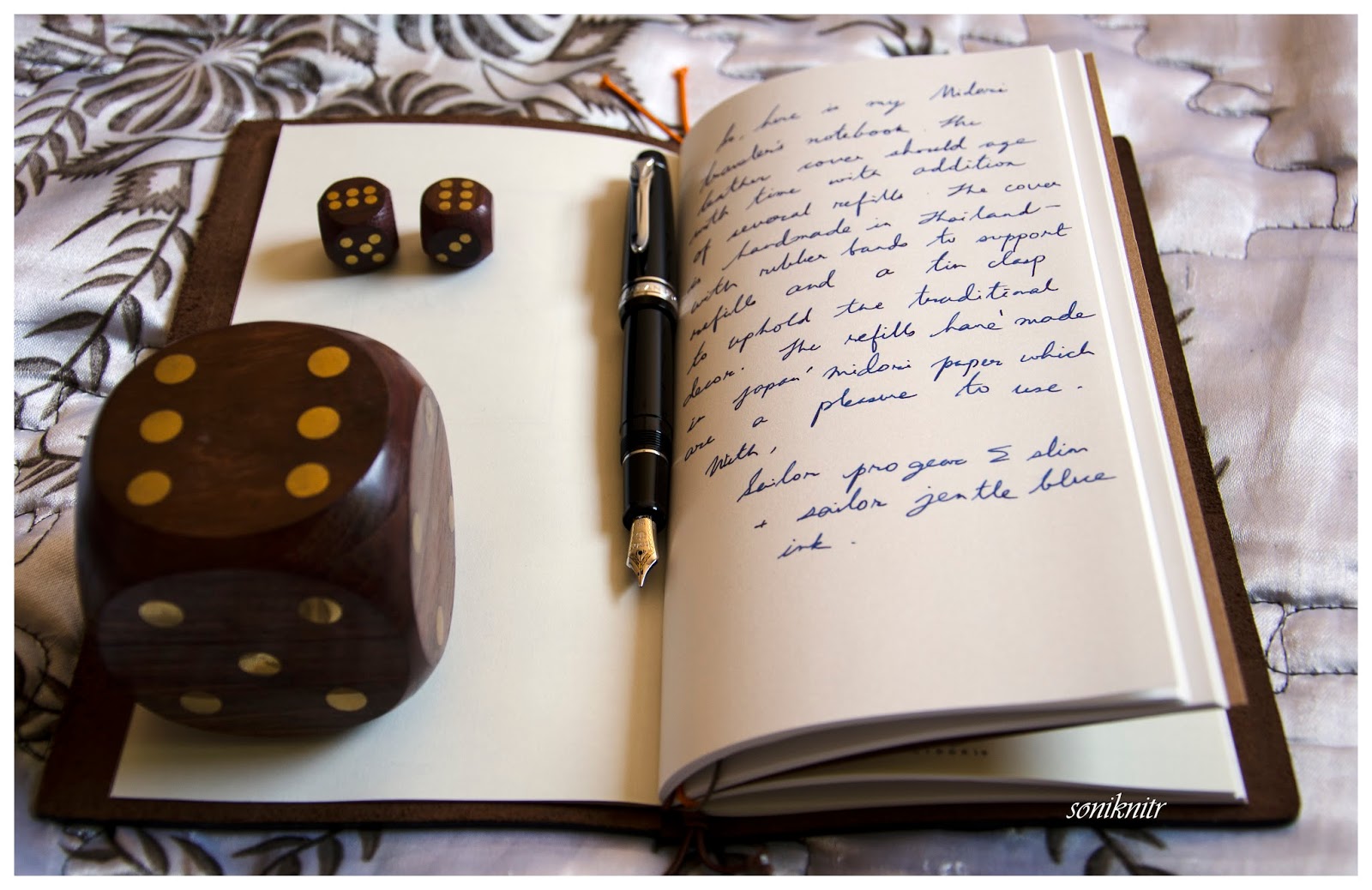
The design and vogue part of the traveler is exquisite. And yes, the MD paper is nice, thick and smooth for all your beloved fountain pens. Since, it was another Japanese product, I tested a Sailor Pro Gear Sigma Slim (Medium) with it. And it did run like a dream, laying quite a fine wet line. The thickness and texture of the MD paper makes even a relatively wet ink dry up pretty fast (sailor jentle ink dried within 6 seconds). However, that again comes with an little although unnoticeable bit of feathering, unlike the parker notebooks. However, there is no bleed-through for the MD paper.

It was fun reviewing the Midori Traveler's Notebook. Hope you enjoyed the review.
You can also find a review of Traveler's Notebook (Passport Size) here.