Monday, January 15, 2024

A Review of the Montblanc M in Red

PRELUDE

In the search of suitable replacements for a Meisterstuck Doue FP 145


My meticulously planned fountain pen hiatuses are occasionally disrupted by the well-meaning members of my family. Instead of appreciating my carefully timed fountain pen acquisitions, they enthusiastically offer advice on investments, the time value of money, and everything in between. To add a twist to the tale, they threw me a curveball last year by gifting a Meisterstück Doue FP 145 LE, even though I had only bought a total of three fountain pens in the last three years. If we exclude the Opus 88, then it's just two.
The Doue 145 is undeniably a beautiful pen, but I found myself wondering if I could ever use it with its slim metal section and rather shortish nib. Determined to find a more suitable replacement, I revisited the local MB Boutique. While Montblanc's customer service remains top-notch for pens within the two-year warranty period, they seem to derive more delight from pens outside the warranty period than their customers do.

    Faced with the task of choosing two pens to match the value of the pricier Doue, I was drawn to a Naruto LeGrand 146. Then, the salesperson revealed his secret NOS drawer, housing various pens, including a Great Characters Walt Disney FP. Opting for the Montblanc M, not only because its 2018 price, combined with the Naruto, matched the total credit value for the Doue, but also because it simply looked nicer.


PRESENTATION (6/6)

Usual MB 


The usual MB single pen box. The standard Montblanc single pen box with no customisation, with the only variation being the red cardboard sleeve that encases the box. The RED collection boasts a charitable initiative, contributing less than 1% (€5) towards fighting HIV/AIDS programs. It's almost as if Montblanc is tackling HIV/AIDS single-handedly, making minuscule donations of €5 at a time, all while charging the end customer a whopping €540+. As Master Yoda famously said, “Do or do not. There is no try”.

    The pen securely nestles within a cushioned and somewhat snug slot inside the box, accompanied by a complimentary cartridge filled with black ink. However, it seems that most of the ink inside the cartridge had evaporated during its 5 years of shelf-living.


DESIGN (6/6)

From the likes of the Apple Watch 


The Montblanc M, available today in three finishes—Ultra Black, RED, and RED Signature—has been designed by Marc Newson, renowned for his work on the Apple Watch. Newson has successfully blended functionality with elegance, anchoring the design firmly outside the tradition for Montblanc.
The shape of the pen is particularly appealing in modern pen terms. It boasts a perfect cylindrical shape with zero taper and rounded ends, except for the flat section, commonly referred to as the “plateau” at the end of the barrel. The platinized clip is a personal favourite; it avoids the cheap look of the Safari, perhaps because it's not oversized and doesn't unlawfully occupy a third of the cap's surface area.
The glossy and bright red finish mirrors background lights and hues effectively. Upon uncapping, one notable feature is the novel use of magnets to secure the cap. The snap cap rotates itself to align its magnetic poles perfectly, ensuring the clip and plateau on the barrel are perfectly aligned on a plane. A soft snap securely seals the cap, earning full marks here. According to Red Dot Project award records, the snowflake emblem made of white resin is ultrasonically welded onto the plateau and then milled with a diamond tool to maintain flatness. The design reflects a harmonious flow and is truly eye-catching.
The cap, adorned with the snowflake emblem on top like regular Montblanc pens, exhibits impeccable overall quality of work. In certain lighting conditions, the magnetic insert is faintly visible inside the cap.
The knurled platinized metal section adds enough weight to balance an otherwise light barrel. Due to the flat plateau on the barrel, the cap cannot be posted. The section, embossed with the MONTBLANC brand name five times on the visible rear ring where the cap snaps on, is somewhat short and not ideal for longer writing sessions. More on that later.


FILLING & CLEANING SYSTEMS (4/6)

Cartridge & No Converter


This is where, like many other fountain pen users, I express my concerns. It's worth noting that this pen only supports standard international short cartridges, and none of the available converters are compatible due to the featured plateau on the barrel. On the positive side, the pen accepts short international cartridges or proprietary MB cartridges, limiting its cartridge capacity to 0.5 ml. The form of the pen, while aesthetically pleasing, somewhat restricts its functionality as part of the design. Perhaps because the pen was conceived in this digital age, the designer didn't anticipate it being used extensively.

Additionally, cleaning the section with running tap water is an easy process.


NIB - ALL THAT MATTERS (6/6)

The two toned rhodium ruthenium stunner


The 14k nib is claimed to be handcrafted by Montblanc in a series of 30 steps. Rhodium-coated with a dark grey ruthenium-coated inlay, this nib is a stunner. I particularly love the shape of the nib, which comes in two widths - Fine and Medium, as far as I know.

    A dazzling cylindrical flow of silvery rhodium bounds the dark grey ruthenium inlay with well-defined contours. Just below the circular breather hole, the 'M' logo rests within an encircled star. The tail end specifies the composition 'Au585' of the gold-alloy, and the brand name 'MONTBLANC' rests just above the tail. Between those, a hallmark of 'StOD' with a crossed ellipse adds a touch of elegance. As always, the nib itself doesn't mention the width explicitly, but a sticker at the piston end of the barrel provides all the necessary details.

Once you turn the nib, you'll behold a somewhat unconventionally shaped black glossy feed that seamlessly matches the curvature of the pen. Apart from an air hole, there is nothing else in the feed, although the nib runs almost medium wet.


PHYSICS OF IT (5/6) – RELATIVELY SPEAKING

The Newtonian Laws


The overall capped length is around 14 cm. As perhaps mandated by Mr. Newson, I have to use the pen un-posted. Although the section has a somewhat comfortable girth, the shortest length of the section of around 2 cm with a step from the barrel does make it less than ideal to use it as a workhorse. The metallic section balances the weight of 19g pretty well.


Below are the pictures along with a Conid Minimalistica for a comparative reference. The Minimalistica is super comfortable for me, here are the dimensions for the Montblanc M.

  • Uncapped Length ~ 12.5 cm
  • Total Length ~ 14 cm

  • Exposed Nib Leverage ~ 1.6 cm (A #6 nib has typically 2.4 cm)


The weight of the pen is comforting even without the cap.

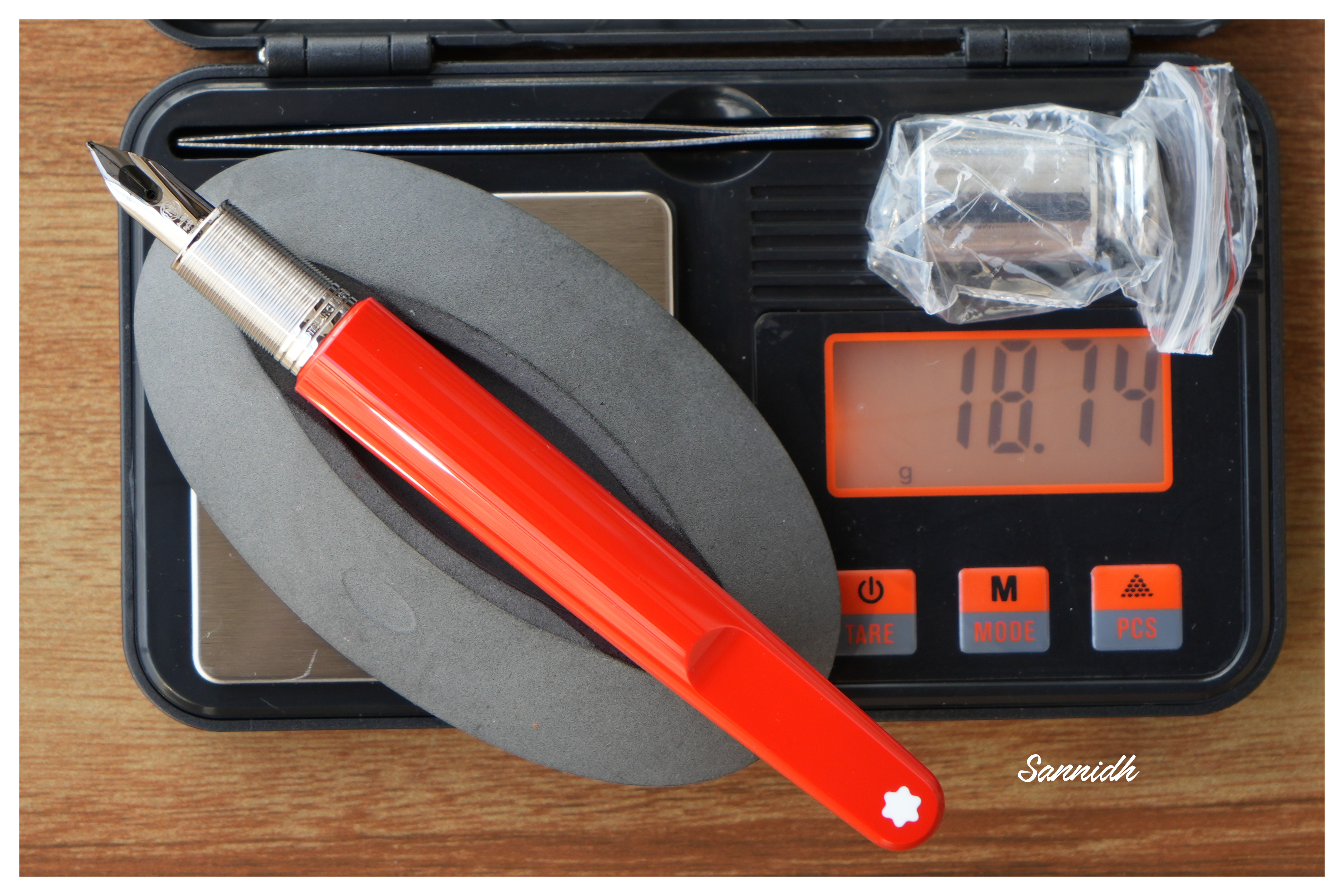
  • Overall Max Weight ~ 27 g (with a cartridge, without cap ~18.75 g)


ECONOMIC VALUE (0/0)

FOC for me


No comments. No rating, as I paid nothing :)


WRITING & FINAL COMMENTS (5.4/6)

Writes well


The writing experience is quite pleasant, albeit with a relatively stiff nib. It does possess a hint of tooth and precisely the kind of control you'd expect from a well-tuned nib. There is a certain degree of softness in the nib, though minimal line variation occurs with pressure. Lines dry in 30 seconds with MB Toffee brown ink on Endless Regalia 80 GSM paper, and the line width is sufficient to display some shading. The nib skipped on the black cartridges (the salesman included a couple of cartridge packs), but it performs flawlessly on the brown ones, offering a steady ink flow with no drying issues.

However, the length of the section, along with the step, leaves something to be desired in an otherwise excellently designed fountain pen. The nib leverage is minimal, so you inevitably touch the step from the barrel. With sweat, the knurling on the grip loses efficiency, unlike a Conid Kingsize with a titanium section. The weight, balance, and aesthetics of the Montblanc M surpass present standards. I believe Montblanc has successfully created a modern pen.

Thank you for going through the review. 
You can find other pen and paraphernalia reviews here. 

  
REFERENCES

Thursday, December 31, 2020

Panchu Pandava Caves @ Bhubaneswar

T-1500 years into the valour of the last Dwapara 

A chance discovery yesterday, led us to a rather impromptu visit to Panchu Pandava Caves today. It's located in Old Bhubaneswar, Odisha not far off from the more famous Rajarani Temple. A touch with the vibrations of dharma in the end of this rather remarkable year 2020. We cycled the short distance and it was an enjoyable ride along with chilly gusts of a pleasant winter.  

          A signboard by Odisha Tourism at the entrance, dates the monument between 500 & 600 AD. 

                The caves were renovated with the help of ASI (Archeological Survey of India) in the recent past. On entering the courtyard for the first set of 5 caves, a large banyan tree and a well will welcome you from either sides. 

These caves have been converted into a temple for the worship of Lord Shiva. The Pandavas are often depicted worshipping Lord Shiva in other texts. The Pandavas refer to the five Pandu brothers: Yudhisthira, Bheema, Arjuna, Nakula, Sahdeva and their wife Draupadi from the Hindu epic, Mahabharata.

                There is a priestly family who serve the temple with the daily puja rituals. I met the youngest in the family and his mother. He performed a puja specific to my name and Hindu root, with clear syllables in Sanskrit. He also mentioned that the Pandavas remained here for an unknown period of time during their Agyat Vaas (12 years incognito) of their famous 13 year exile. The deep well outside, dates back to the times of their stay too.

The first partition of the temple is dedicated to Lord Shiva & the Trinity along with a statue depicting the Pandavas and their mother Kunti. The next partition depicts Goddess Durga along with a few manifestations of Divine Mother. Paramhansa Yogananda had mentioned that he was born as Arjuna during those times and his most advanced disciple Rajasi had been Nakula then. So the Pandavas are in many ways closer to the heart of many Kriya Yogis. I meditated in this cave for a few minutes, with calming vibrations of fearlessness.

 Here is a closer portrait of the statue depicting the Pandavas.

A cavity on the roof of the cave, was possibly used to keep a vigil on the outer gardens. It seemed to be resembling an area with dense vegetation.

                  Exactly below the cavity was another tunnel which connects to the Khandagiri Caves, at a distance of 12 kms by road. The tunnel is now closed and the ground is covered by tiles and marbles. You can always see the other end of this tunnel at the Khandagiri Caves, is what the priest explained. Once we bade our goodbyes, we went on to visit the other cave sets.

There are two more set of caves towards the right which have been renovated with roofs and gates. Unlike the temple cave however, they are not used.


A huge mound has been created by white ants in the last set of caves. Probably years of hard work in their own Agyat Vaas!

We had to bid final goodbyes to our little friend, who was busy with its brunch.


Sunday, February 23, 2020

A Spanish sail with a Moroccan excursion

MUMBAI – DELHI – MADRID – RABAT – MADRID – DELHI – MUMBAI


The trip to Spain & Morocco was a long awaited one for both of us. Especially since it was a year, when we had gone out for a holiday together. And then the BLS lady had made us run to their processing office, that too twice on a trifling matter, which was later resolved within minutes by her colleague. Though we had inwardly prepared ourselves for an adventure filled December.

VISA 
For Spain, BLS International (as of date) is the authorized agency. You can download the form in PDF format and complete it using the fill form feature in acrobat reader. You can book an appointment at the visa submission office in your city and submit all required documents with a print of this form. The visa once approved, would be a Schengen type visa. We applied for a multiple-entry visa, since we were doing Spain & Morocco together.
              For Morocco, it's a similar process with CKGS (Cox & Kings Global Services, as of date) and typically you would need to pay by cash, at their office. They would in turn send the visa application to the Embassy of the Kingdom of Morocco at New Delhi, for the approval. 

We had done our bit of research on the weather in the cities we planned to visit, in December. It was quite cold in Madrid, while it projected a warmer climate in Seville. Morocco was warmer towards Marrakech. We were armed with down-jackets, sweaters and gloves to brave the chilly winds, or so we thought!

The flight booking was done with Air India and it was the cheapest round trip comprising a domestic leg. The journey was pleasant, once we would convince the staff in the check-in counter to allow us to take the Delhi flight, for we had an onward international flight too. I am really amazed, how Air India manages to fly itself with such an acute shortfall in staff! We reached Madrid at midnight, and it was 5°C outside. And the next morning, we had to go to Barcelona. So, we took a T10 Metro ticket from the airport machine for internal travel.
For longer distances, we used renfe trains. A €195 pass for 4 trips is usually economical for tourists, you can book tickets later as long as they are available. The tickets can be booked on renfe website. However, it's advisable to take a print of the pass as well as the booked tickets, from one of the renfe centers. 
From now onwards, let the pictures speak!

Barcelona, Spain


While we took a walking tour with Sandemans to view major parts of the city, including war histories, the main attraction was the Basilica of the Sangrada Familia. Though, we went to the beach in the evening, before Sangrada day.

Basilica of the Sangrada Familia


The Basilica was designed by a famous artist named Antonio Gaudí in the mid 1900s, and the church is projected for completion in 2026, through tourism and public visits.

               It has three towers dedicated to Saint Joseph, Virgin Mary & Jesus Christ. On the outside it's engraved with storylines starting from the visit of three wise men to Jesus's crucifixion. Gaudí (albeit a bit true to his name), has depicted the structures remarkably in form of waves arising out of a center (using conic sections - parabolas, hyperbolas & polygons). 

The pillars are branched to mimic nature (tree of life), and are made of different materials (weight bearing capacities) starting from sandstone, then granite, and finally the heavily loaded red coloured hematite (2nd to diamond they say) for supporting the central dome. Now it’s developed through modern engineering methods - 3D printed models. The lab can be seen during the course of the museum visit.
As per our guide, blue & green coloured stained glass depict ocean and nature, the yellow & red on the opposite side depict flesh and blood.

Gaudi had his unique way of using scaled models, by suspending weights (lead) from a drawing board in small bags, to calculate structural dimensions. And then he inverted/mirrored those to depict the final shape of the monument. One such example can be found in the museum.
The cityscape gets even better with dusk.

Toledo


It was time to take the train back to Madrid and then change to a smaller renfe train for a half an hour journey to Toledo. Toledo was an ancient city of importance during the Roman times and is build like a fortress. When we arrived in Toledo, it was quite windy and misty. We couldn't see or feel much with our frozen hands! Tagus river can be seen flowing through the city.

The railway station at Toledo is beautiful and welcoming.
The city has multiple cultural influences including Romans, Jews and Moorish rulers. We saw many shops with exquisite metal work in form of swords, knives, jewellery and other accessories. There are many gates to the city built during different reigns. While visiting famous monuments, you will come to cross some of them.
One of the city gates we visited is called Puerta del Cambron, which bears the coat of arms of the Kingdom of Castile and Leon. Two of the famous kings of Spain are King Ferdinand III (who is also called the Saint, his body it is said is incorruptible to this day) and his successor Alfonso X, whose work can be seen in several parts of the city.
The Roman bridge, Puente de Alcántara, can be seen spanning across Tagus river.
The Alcázar of Toledo (the highest building, now used as a library), stands tall with the fading sunbeams of dusk. 
And then the moonbeams shine through the path of Camino de Guadalupe.

Rabat, Morocco


We took a train back to Madrid and took the next Ryanair flight to Rabat. Ignoring the plethora of taxis, we took the Alsa bus from airport to Rabat Ville (train station). You would need some currency to be exchanged (to Moroccan Dirhams) in the airport itself, for payments outside of your prepaid bookings. Keep in mind that it's a closed currency, so you would need to spend all of it. Other places of exchange can be found in railway stations.

                Our booking, was in a hotel inside the medina, which is a kind of common living structure in some of the North African countries. You would not see boundaries between the houses and a common parking area, common markets etc. The central markets are quite a sight! A small little bird was there to say 'Hi' to us in the morning. The food is nicely prepared with Moroccan spices and has a tang of Indianness to it.
We went to a few places in the following morning, including Saint Peter's cathedral, and the fusion of French and Arabic architecture is remarkable. The finesse of the netted architecture will hold your eyes.
One of the gates to the King's palace
The Rabat lighthouse can be seen through seaming seas & glittering lights in dusk. It near one of the medina gates. A resting place for their loved ones lie on either sides.

Marrakech, Morocco


We took a train to Marrakech. It takes around 4 hours from Rabat Ville and those trains are quite comfortable and well made. You would pass the Altlas mountains and see a bit of the distant snow caps, while approaching Marrakech.
     
       One of the places we visited is Jardine Majorelle which was designed by French artist Jacques Majorelle. Jardine means garden, which we found out in turn. This property was purchased by French designer Yves Saint Laurent and Pierre Berge, who restored it. The plants are cultured from different nations.

Hues of blue(palatinate?) and yellow decorate the gardens with a few museums. Colorful fishes swim in the water tanks amidst the chic houses. The remains of Yves Saint Laurent are buried there.
We also visited the Bahia palace which means brilliance. Fused with Islamic and Moroccan architecture, it's quite a sight to look at.
The back courtyard of the 2 acre palace and gardens is famous on instagram!
Returning back to the medina, we went through many of the markets.
The evening markets are also quite a sight!

Casablanca, Morocco


A few places to be seen mostly as a part of a day trip includes of course the beautiful beach, a view of Rick's cafe (which was not existent when the film was shot), and a few other monuments.

Rabat, Morocco


After returning to Rabat, we visited a few other places including the Chellah or Shalla which has some ancient Roman ruins.
It is home to many a storks, who can be found sitting lazily on either the walls or the trees, during this season.

Granada, Spain


            It was time to return to Madrid and take the train to the foothills of Sierra Nevada. One of the famous sites in Granada is the Alhambra palace and gardens, the tickets need to be booked two months in advance.

Alhambra Palace & Generalife Gardens


                      It's a 20-25 min short leisurely trek, into the vast compounds of the moorish rulers. It's said to be a small Roman fortress and had been majorly renovated in the 13th century, by King Nasrid. The entrance is located in the foothills, you may alternately take a minibus, which runs regularly to Alhambra palace.
A view of at the entry point, to the vast Generalife gardens.
It is a mix of both Moorish and Renaissance styles. Below is the patio of palace of Charles V.
Fine carvings in form of arabesques & inscriptions, adorn the interiors with the colorful tile-work!
The ceilings are decorated with fine stalactites and certain parts are being restored.
The doors to many doors and a window inside.
Some of the ceiling paintings depict the moorish rulers hunting, fighting or in meetings!
Snow caps of Sierra Nevada can be seen from one of the towers of the Alcazar.
There is also a beautiful city scape from one of the towers.
Sunset is beautiful from the Alcazar.
A walk to the Gypsy Quarter of Sacromonte, may remind you of Santorini, if you have been to Greece.
Of course, the Christmas decorations were an added advantage during the evenings.

Seville, Spain


We took a bus from Granada to Seville. There was some unexpected rainfall and our host was kind enough to offer us a big umbrella. 

        One of the major sights is the Cathedral of Seville which is a huge structure with numerous doors and the 343 ft. Giralda tower. The bodies of Saint Ferdinand III (incorruptible since 1217) and Alfonso X, are also rested in the cathedral. The crypts are in the royal chapel which is accessible only during prayer hours and closed for tourist tour visits.
A portrait of King Ferdinand III welcomes you to your visit.
Christopher Columbus and his sons are also buried in the Seville Cathedral, for his quests were sponsored by the then queen of Spain, Isabella I. There are multiple capillas and treasure museums inside the capillas. The tour visit would take at least two hours if not less.
A visit to Plaza de Espana was a delight, which was made to host Spanish exhibitions.
We were welcomed by an intermittent rainbow.
Though with much reluctance, we went back to Madrid for our return journey.